
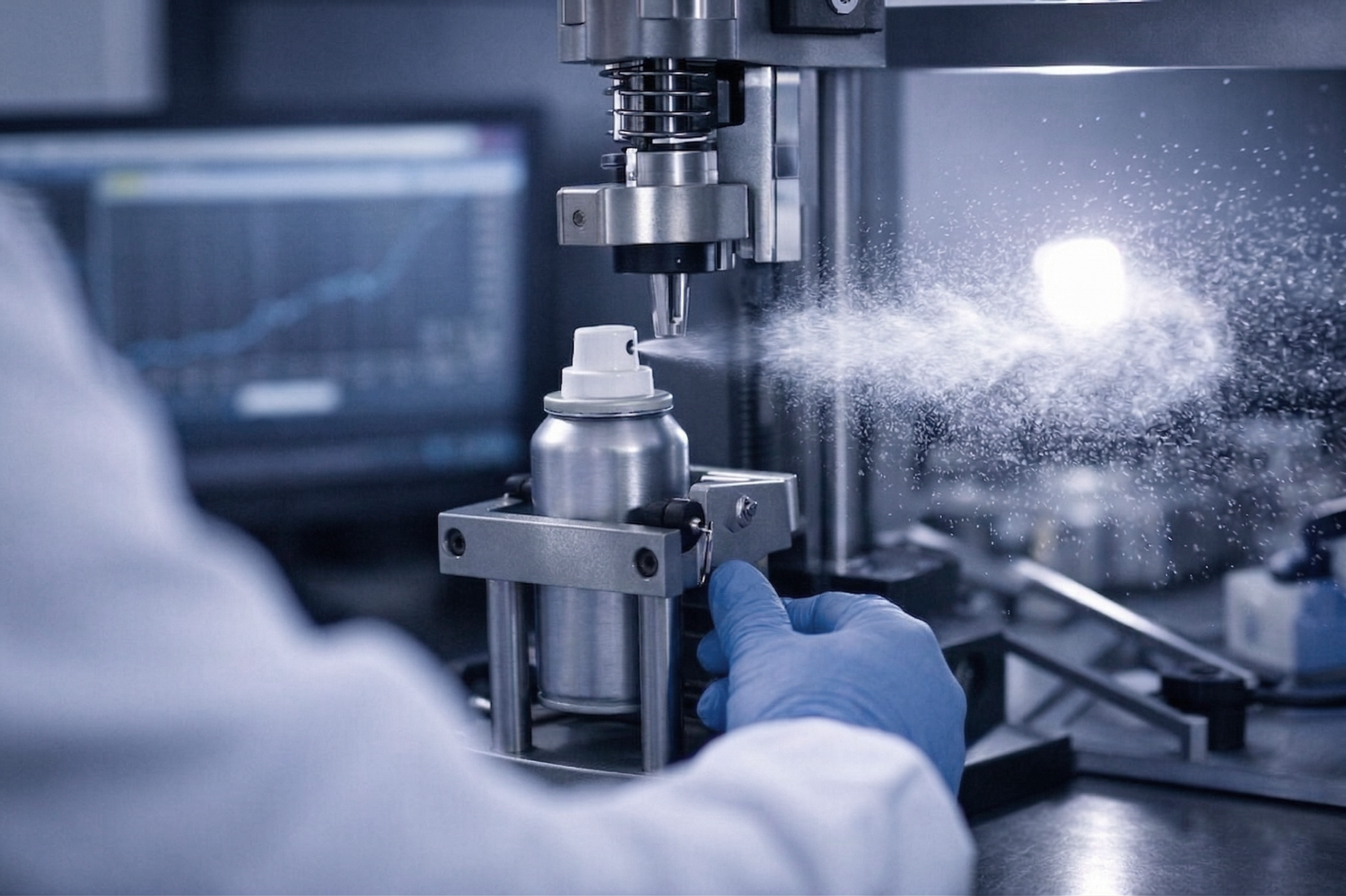
How a spring influences the performance of an aerosol system
In the aerosol and dispensing systems market, attention is often focused on the content itself: fragrances, cosmetic, food or technical products. Yet the quality perceived by the end user also depends on a hidden component: the spring that controls the return movement of the dispensing mechanism and determines its mechanical response at every activation.
Within a complex supply chain — involving container manufacturers, filling companies and spray system suppliers — the spring directly affects gesture repeatability and operational stability throughout the usage cycle.
How the spring works in aerosol dispensers and why it is a critical component
The spring is designed to ensure:
- correct product release
- immediate return of the system to the closed position
- continuity of the user experience
This apparently simple function is highly sensitive to design and production variables. Even minimal variations in the spring constant or deviations in tolerances affect system response and generate perceptible differences from the very first usage cycles.
How an unsuitable spring can generate critical issues
In real industrial applications, the most common problems associated with a spring designed or controlled inconsistently include:
- Variations in force over time: even small deviations in elastic characteristics can generate non-uniform dispensing over repeated cycles, creating differences between production batches.
- Incomplete return of the mechanism: a spring dimensioned inconsistently with the application can compromise closure, affecting sealing, safety and production continuity.
- Interaction with fluids: in the presence of cosmetic, food or chemical substances, materials and surface treatments must remain compatible with the content to ensure long-term stability.
- Processing residues: the presence of oils or contaminants can affect sensitive applications, particularly in food contact sectors, in relation to application requirements and required cleaning protocols.
These conditions translate into concrete effects on finished product reliability and compliance with regulatory requirements, with measurable impacts on production continuity, scrap management and batch consistency.
How to balance costs, quality and technical requirements when selecting springs for aerosol systems
The aerosol market is characterized by low unit values. Every component therefore requires economic optimization combined with high quality standards.
This balance is based on:
- high-precision production technologies
- advanced levels of automation
- controllo rigoroso dei parametri di processo
The ability to maintain tight tolerances across high production volumes represents a decisive competitive factor.
Depending on the target sector, springs must also meet specific application requirements:
- in the food sector: contamination control and compliance with safety requirements
- in the cosmetic sector: neutrality with respect to odors and interactions with formulations
- in industrial applications: resistance and functional stability
A low unit value component with high technical responsibility
The spring used in aerosol systems is a low unit value component with high technical responsibility. Design and manufacturing require engineering expertise, material knowledge and process control.
The difference between a system that reaches expected functionality and one that maintains a stable response over timedepends on these elements, which act on precision and repeatability.
In this context, the ability to work with tight tolerances, manage high volumes with consistent quality and rapidly develop prototypes represents a concrete criterion when evaluating a supplier.
An approach based on advanced automation, process control and consolidated technical expertise makes it possible to obtain components with predictable and repeatable behavior throughout the product lifecycle.
On these foundations, companies such as Mollificio Valli support customers in defining the most suitable solutions for specific applications, with constant attention to quality, compliance and functional stability.
Component selection therefore becomes a true design lever, directly influencing system behavior and the end-user experience.